01 Dealer’s notes
SEIKO CHRONOS — QUIET PRECISION FROM 1986
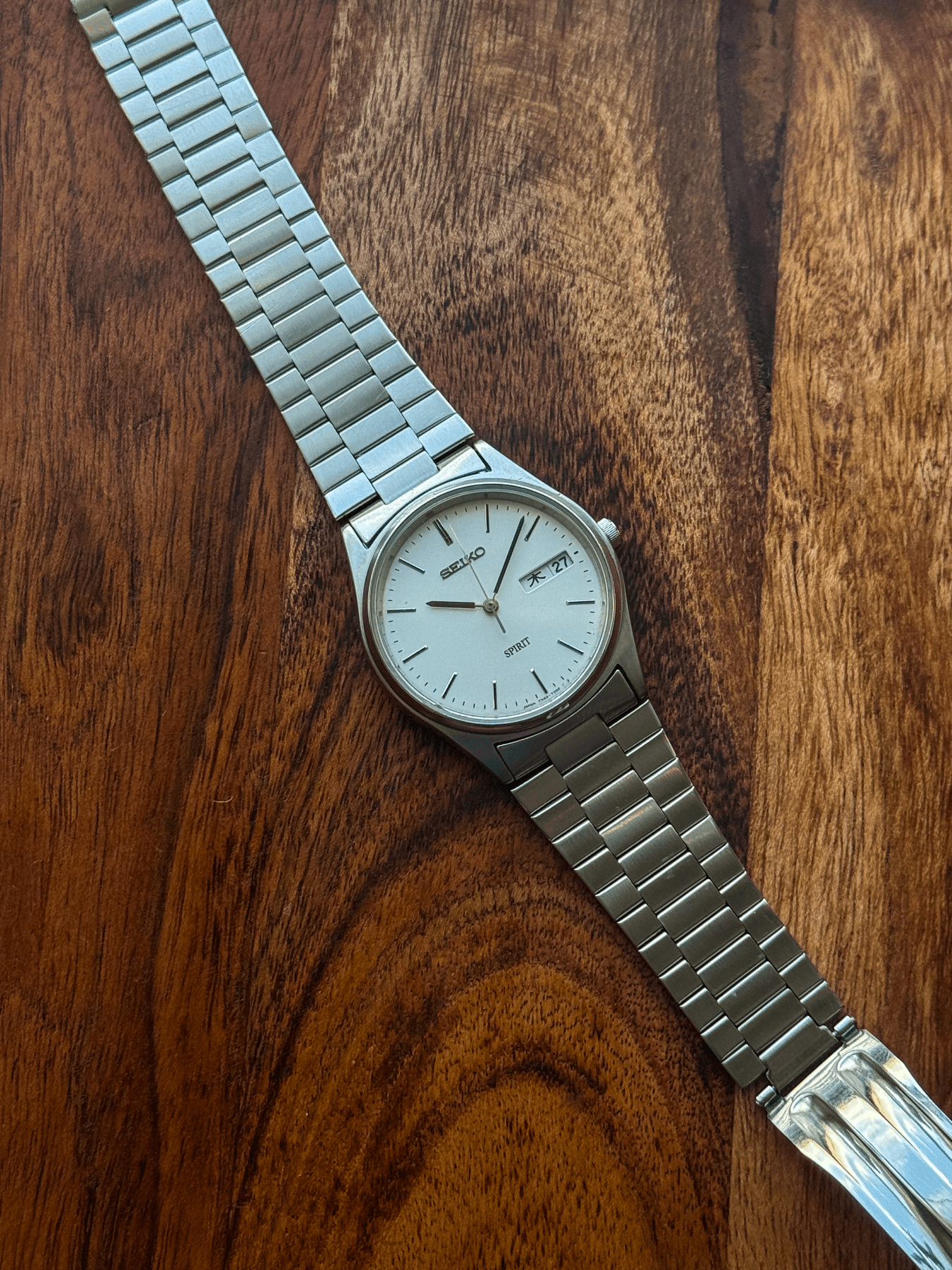
By the middle of the 1980s, quartz was no longer something Seiko needed to prove. The technology that had disrupted the watch industry was now mature, dependable, and increasingly refined. The Chronos 8123-6310 is a product of that period: a June 1986 Japanese-market Seiko built not around novelty, but around the idea that an everyday quartz watch could still be thoughtfully designed and beautifully finished.
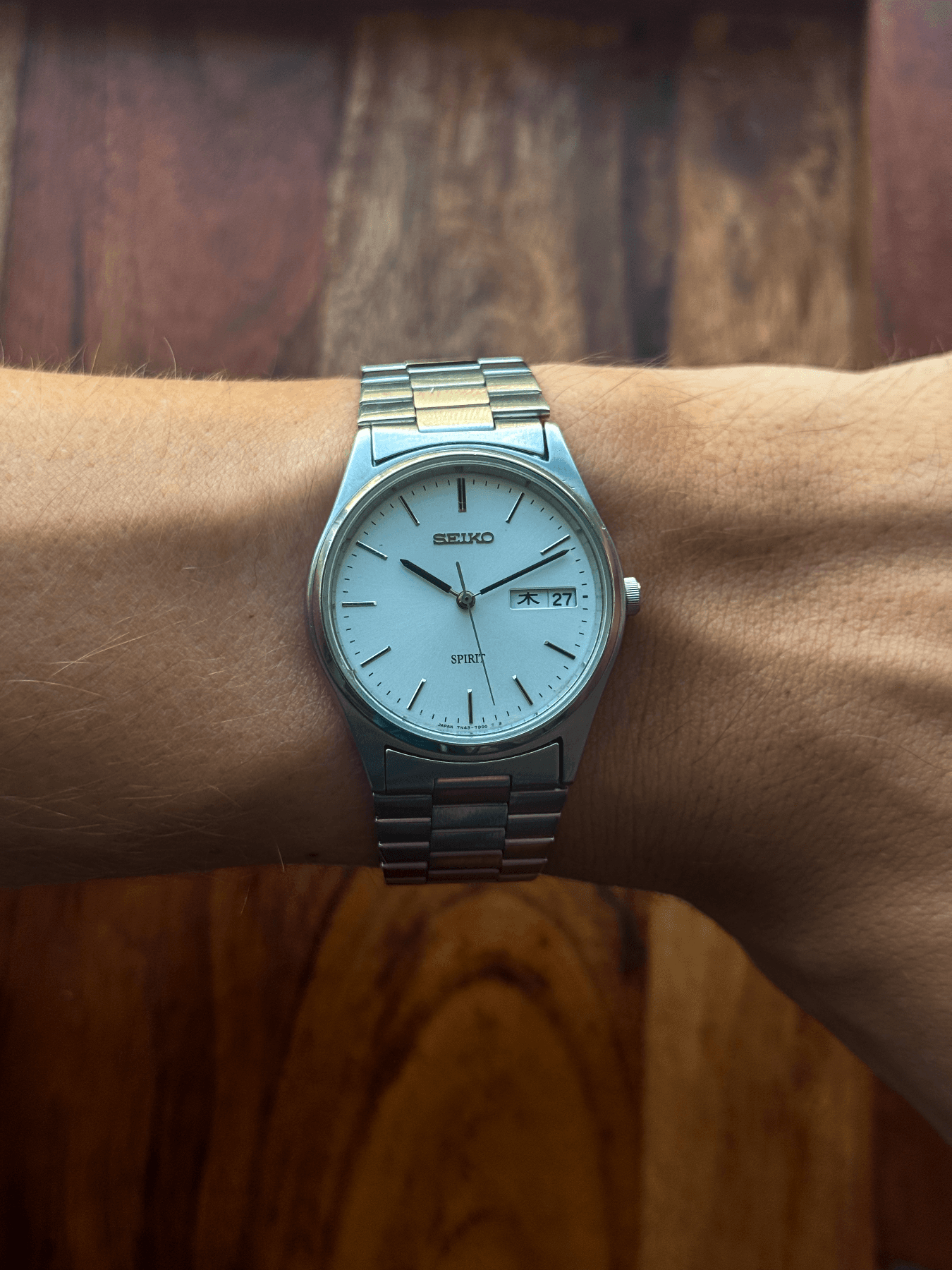
Its dial is almost aggressively restrained. A clean silver-white surface is interrupted only by slender applied markers, the Seiko signature, a small italic Chronos script, and a day-date aperture at three o’clock. The Japanese/English day wheel adds one unmistakably domestic-market detail, while the narrow luminous hands provide just enough contrast to keep the watch functional without disturbing its minimalist character.
Around it, Seiko gave the 8123-6310 a sharply defined stainless-steel case that feels distinctly more architectural than its traditional round dial suggests. Polished surfaces meet brushed sections around angular lugs, flowing directly into a fitted steel bracelet. At roughly 32 millimeters across, its proportions belong unmistakably to its era—compact by modern standards, but thin, balanced, and particularly well suited to the integrated geometry of the design.
Inside is Seiko’s caliber 8123A, a five-jewel analog quartz movement with day and date, hacking seconds, and a factory accuracy specification of approximately ±15 seconds per month. It represents a fascinating point in Seiko’s history: quartz engineering had become commonplace, yet movements like the 8123A were still constructed with a degree of mechanical refinement rarely associated with inexpensive quartz today. More than forty years later, the Chronos remains an understated example of what Seiko did exceptionally well during the decade—taking advanced technology and making it feel completely ordinary.
Three points to note.
June 1986 production — serial 662629 places this example in June of 1986.
Japanese-market day wheel — the bilingual Kanji/English day display is a distinctive JDM detail.
Five-jewel caliber 8123A — a higher-spec Seiko quartz movement rated around ±15 seconds per month, with day/date and hacking seconds.