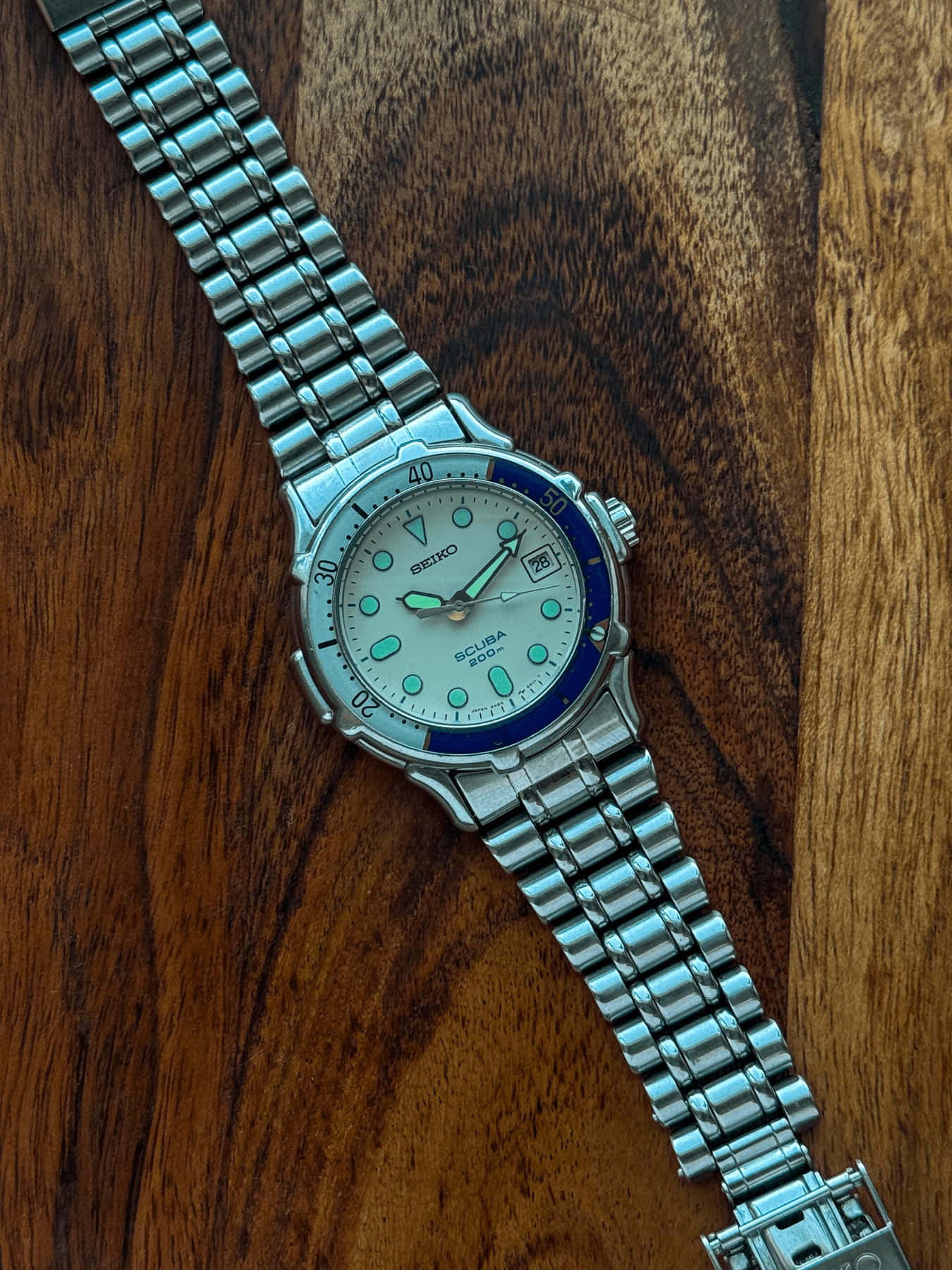
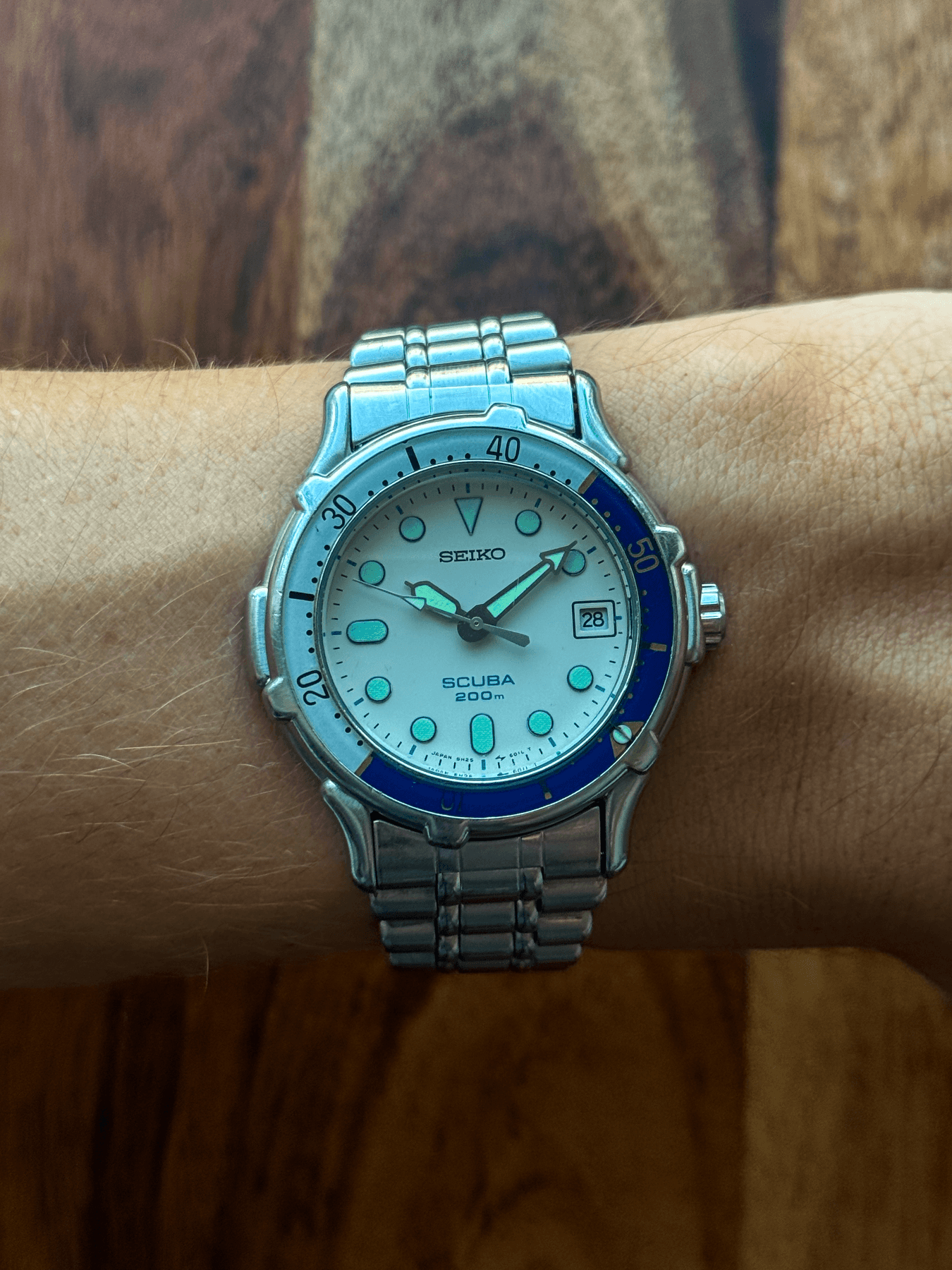
01 Dealer’s notes
1978 SEIKO TYPE II — BLUE TRICOLOR DIAL
In the late 1970s, quartz represented the cutting edge of Japanese watchmaking, and Seiko was leading the charge. The Type II collection belongs to this remarkable period—an era when quartz watches were engineered as precision instruments and treated as objects of real design significance. Introduced at the height of Seiko’s technological ascent, the Type II combined advanced electronic timekeeping with the sharp casework, expressive dials and distinctly Japanese design language that make the company’s 1970s watches so collectible today.
This 1978 reference 7546-8350 is dominated by an extraordinary three-part blue dial. A vivid metallic blue stripe runs vertically through its center, bordered by darker navy sections that can fall almost to black depending on the light. The effect constantly changes as the watch moves—at one angle restrained and nearly monochromatic, at another an electric flash of cobalt blue. Applied silver baton markers, slender hands and the framed day-date window keep everything crisp, while the small Type II emblem at six o’clock quietly identifies one of Seiko’s most interesting late-1970s families.
Around it is pure period Seiko: an angular stainless-steel case with broad planes, a polished bezel and compact vintage proportions, flowing directly into a substantial stainless bracelet. There is something almost architectural about the design. The restrained case gives the dial room to do the talking, while the bracelet carries the same mixture of brushed surfaces and sharp geometry through the entire watch. It feels unmistakably 1970s without becoming costume-like.
Inside is Seiko’s caliber 7546, a remarkably sophisticated quartz movement from the company’s formative quartz era. It offers a quick-setting day and date, hacking seconds and a bilingual English/Kanji day display, and was originally engineered for accuracy within approximately fifteen seconds per month. Nearly half a century later, the 7546-8350 is a reminder of what early quartz once represented: not compromise, but progress—wrapped here in one of the most striking blue dials of the Type II generation.
Three points to note
August 1978 production — Serial 883258 places this example firmly in Seiko’s early quartz era.
Blue tricolor dial — Three vertical metallic-blue zones shift dramatically from deep navy to vivid cobalt as the light changes.
Caliber 7546 — A serviceable Japanese quartz movement with hacking seconds, quickset day/date and a bilingual English/Kanji calendar.